2003-2008
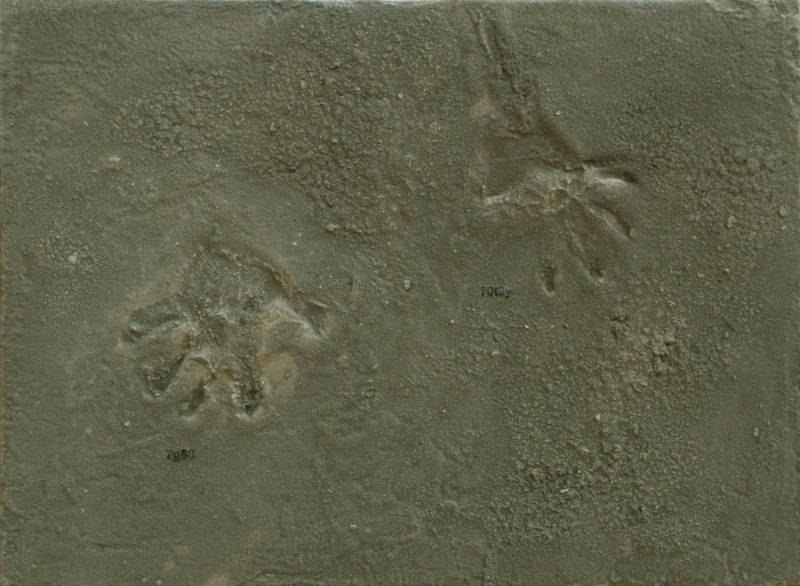
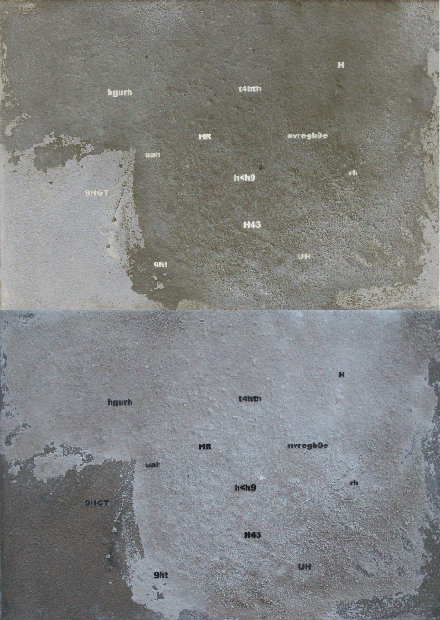
The use of matter to express and emphasize its corruption and impermanence would be confirmed in this next stage as a decidedly accepted, consented, and sought-after resource. During these years, it would not only be the varnish that suggested corruptibility; now, furthermore, waste and debris would be used to enrich the surface of the exercise and to suggest—or more specifically, to explicitly describe—an intense instability in matter.
At the same time, the incorporation of encodings would become established, embedded within the personal language of the works. Their inclusion became accepted to the extent that, in every exercise, their incidence from the electric would persist and become increasingly necessary. For the work, the exercise, would only then seem to describe a possible final state—definitive at the moment when, upon that screen-skin, the encoding would grant it plausibility.
A strange and intuited paradox would then be suggested in detail: an ontological controversy regarding the source of information. This would later be studied and reflected upon through the reading and analysis of numerous articles and investigations, finally leading to a reasoning of a discussion still current in the fields of theoretical physics and quantum mechanics.
We could say that, in a way, the work—that substance arising from intuitive and natural labor—would only acquire sufficient entity and plausibility to the extent that the encoding inferred a reference upon it, perhaps as a form of acceptance, approval, or calculation of its characteristics, magnitudes, or expressions.
A paradoxical exercise of creation that blurs the artist’s expression as they submit to their own debate, their own analysis, and their own artistic expression. It describes a way of interpreting a counterintuitive and especially attractive controversy, likely useful for participating in the debate where theoretical physics discusses with quantum mechanics.